Industrial Frankenstein (I)
One Book One Northwestern, 2021–22
In 1933 and 1934, Chicago hosted the World’s Fair, which was also planned as a commemoration of the city’s centennial. Dubbed the "Century of Progress," the fair encouraged visitors to celebrate great strides in industrial innovation—from new methods in agricultural production to the modern car.
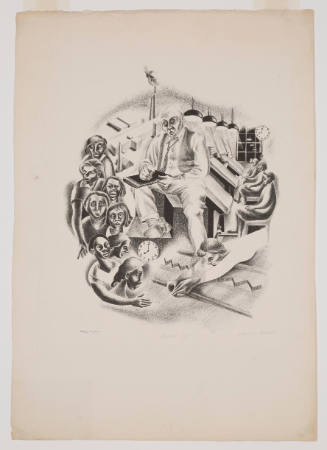
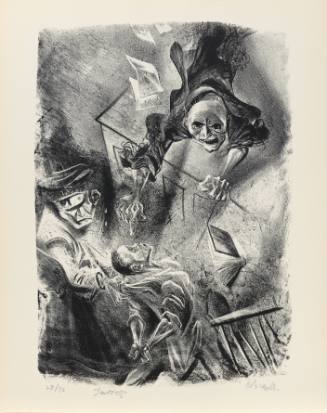
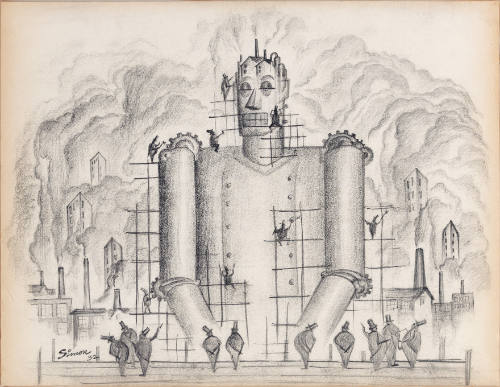
When selected to design panels for one of the fair’s pavilions, Chicago-based artist Henry Simon chose the theme of an "Industrial Frankenstein," an icon that loomed large in pop culture but also subverted the fair’s narrative of progress. In the bold preparatory drawing, an android with smokestacks at the crown of his head emerges from a smoggy cityscape. Tiny, shadowed men in suits and top hats tinker with and admire the robotic figure. Tensions around class and labor were especially heightened during the Great Depression. At the time, Simon was an active member of the John Reed Club, a leftist organization of intellectuals and artists who believed that, in time, the working class would destroy the capitalists that unjustly profited from their labor. Appropriately, in the third drawing of this series, Frankenstein rises up, shakes off the shackles of his scaffolding, and sends the businessmen scurrying. The image serves as a warning for a society that allows profit to dictate action, a caution echoed throughout The Story of More. As Jahren noted, "There is only one problem: driving less, eating less, buying less, making less, and doing less will not create new wealth. Consuming less is not a new technology that can be sold or a new product that can be marketed…."